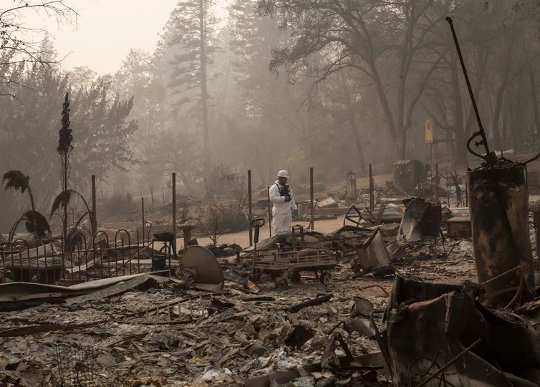
 Debris in Paradise, California, after the Camp Fire, Nov. 17, 2018. Senior Airman Crystal Housman/U.S. Air National Guard, CC BY
Less than halfway through the 2020 temporada de incendios forestales, fires are burning large swaths of the western U.S. As in previous years, these disasters have entered populated areas, damaging drinking water networks. Water systems have lost pressure, potentially sucking in pollutants, and several utilities are warning of posible y confirmed chemical contamination.
No somos ambientales ingenieros who help communities affected by disasters, including support for responses to the 2017 Tubbs Fire and 2018 Camp Fire in California. As we concluded in a recently published study of burned areas, communities need to upgrade building codes to keep wildfires from causing widespread contamination of drinking water systems. They also need to act more aggressively to protect residents from possible toxic exposure immediately after fires.
How wildfires poison water systems
After both the 2017 Tubbs Fuego in California’s Sonoma and Napa counties y la 2018 Camp Fire in Condado de Butte, California, drinking water tests revealed a plethora of acutely toxic and carcinogenic pollutants. Water inside homes was not safe to use – or even to treat.
Wildfires in your area may cause power outages and contaminate your drinking water, even if the fire does not actually reach your home. Have emergency provisions in place before a wildfire strikes! #preparación pic.twitter.com/oT9I9rhzBw
— USFS Fire-California (@R5_Fire_News) 23 de Octubre de 2019

Water pipes buried underground and inside of buildings were extensively contaminated. Both fires destroyed fire hydrants, water pipes and meter boxes. Leaks and ruptured hydrants were common.
After the fires passed, testing ultimately revealed widespread hazardous drinking water contamination in areas affected by both fires. Evidence suggests that the toxic chemicals originated from a combination of burning vegetation, structures and plastic materials.
Chemicals in the air may have also been sucked into hydrants as water pipes lost pressure. Some water system plastics decomposed and leached chemicals directly into water. Toxic chemicals then spread throughout pipe networks and into buildings.
Limited water testing by state and local agencies showed that benceno y naftalina were present at levels that could cause immediate physical harm. These chemicals, as well as cloruro de metileno, estireno, tolueno y cloruro de vinilo, exceeded limits for longer-term exposure.
All of these substances are compuestos orgánicos volátiles – chemicals that readily evaporate into the air at room temperature. Many of them cause cancer. All can cause vomiting, diarrhea and nausea after a brief high-concentration exposure.
Simply running a cold water faucet can release volatile organic compounds from tap water into the air. Heating water for showers or cooking makes them enter the air even faster, creating a more severe inhalation risk. Some can also be absorbed through the skin.
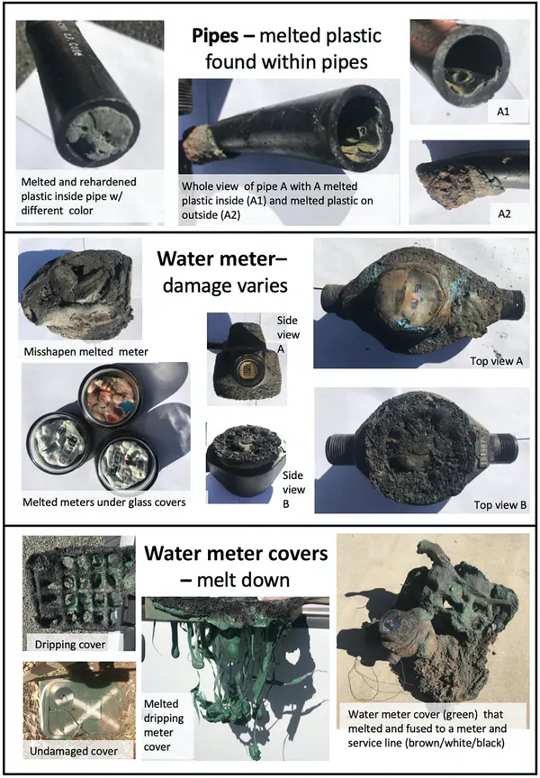 Pipes, water meters and meter covers after wildfires destroyed them. Caitlin Proctor, Amisha Shah, David Yu, and Andrew Whelton/Purdue University, CC BY-ND
Proteger al público
In our view, agencies should not underestimate health hazards posed by fire-damaged drinking water systems. Just in the past month, after the CZU Lightning Complex Fire burned parts of San Mateo and Santa Cruz counties, California officials and a water utility emitido y reeditado an advisory allowing children to bathe in potentially contaminated drinking water. Five days later, when limited test results became available, both organizations recanted and said no one should bathe en el agua.
To avoid this kind of error, we recommend issuing “Do Not Use” orders in the wake of major fires to protect the public before water testing results are available. We believe it is acceptable to use water for fire fighting and toilet flushing, but not for purposes that involve ingestion, skin exposure or inhalation, such as bathing or cooking.
Under no circumstance should people be told to smell the water to determine its safety, as officials recommended for months after the Camp Fire. Many harmful chemicals have no odor, so only testing can determine safety.
Advisories to boil water should not be used, since boiling speeds up the release of toxic chemicals into the air. Nor do we recommend “Do Not Drink/Do Not Boil” advisories, which allow bathing in contaminated water.
Before agencies lift or modify advisories, we believe they should be required to carry out thorough chemical screens of water systems. Too often, officials charged with protecting public health fail to take this step, exposing people to needless risk. More typically, they act like California’s San Lorenzo Valley Water District, which lifted a post-wildfire “Do Not Drink/Do Not Boil” order in parts of its territory on Sept. 7, 2020 with a notice to ratepayers that “If test results reveal anything harmful, you will be advised promptly."
Agencies also need to test buildings for water contamination. Home drinking water quality can differ from room to room, so reliable testing should sample both cold and hot water at many locations within each building.
While infrastructure is being repaired, survivors need a safe water supply. Water treatment devices sold for home use, such as refrigerator and faucet water filters, are not approved for extremely contaminated water, although sales representatives and government officials may pensar erróneamente the devices can be used for that purpose. While survivors wait for safe water to return, government agencies should ensure that reliable emergency water supplies are available.
Update building codes for future fires
Our research underscores that community building codes are inadequate to prevent wildfire-caused pollution of drinking water and homes.
Adopting codes that require builders to install fire-resistant meter boxes and place them farther from vegetation would help prevent infrastructure from burning so readily in wildfires. Concrete meter boxes and water meters with minimal plastic components would be less likely to ignite. Some plastics may be practically impossible to make safe again, since all types are susceptible to fire and heat.
Installing one-way valves, called backflow prevention devices, at each water meter can prevent contamination rushing out of the damaged building from flowing into the larger buried pipe network. Water main shutoff valves and water sampling taps should exist at every water meter box. Sample taps can help responders quickly determine water safety.
As the past several years have shown, many communities need to be better prepared for wildfires. Two years after the Camp Fire, the town of Paradise, California is still clearing and repairing its water system, a un costo estimado de hasta US $ 150 millones. We believe the time to upgrade in other towns is now.
Acerca de las autoras
Andrew J. Whelton, Associate Professor of Civil, Environmental & Ecological Engineering, Purdue University and Caitlin R. Proctor, Lillian Gilbreth Postdoctoral Fellow, Purdue University
Este artículo se republica de La conversación bajo una licencia Creative Commons. Leer el articulo original.
Libros relacionados
La vida después del carbono: la próxima transformación global de las ciudades
by Peter Plastrik, John Cleveland El futuro de nuestras ciudades no es lo que solía ser. El modelo de ciudad moderna que se consolidó a nivel mundial en el siglo XX ha dejado de ser útil. No puede resolver los problemas que ayudó a crear, especialmente el calentamiento global. Afortunadamente, un nuevo modelo para el desarrollo urbano está emergiendo en las ciudades para enfrentar agresivamente las realidades del cambio climático. Transforma la forma en que las ciudades diseñan y utilizan el espacio físico, generan riqueza económica, consumen y disponen de recursos, explotan y sostienen los ecosistemas naturales y se preparan para el futuro. Disponible en Amazon
La sexta extinción: una historia antinatural
por Elizabeth Kolbert Durante los últimos 500 millones de años, hubo cinco extinciones masivas, cuando la diversidad de la vida en la tierra se contrajo repentina y dramáticamente. Los científicos de todo el mundo están monitoreando la sexta extinción, que se pronostica como el evento de extinción más devastador desde el impacto de los asteroides que destruyó a los dinosaurios. Esta vez, el cataclismo somos nosotros. En prosa que es a la vez franca, entretenida y profundamente informada. Neoyorquino La escritora Elizabeth Kolbert nos cuenta por qué y cómo los seres humanos han alterado la vida en el planeta de una manera que ninguna especie ha tenido antes. Entrelazando investigaciones en media docena de disciplinas, descripciones de las fascinantes especies que ya se han perdido, y la historia de la extinción como concepto, Kolbert proporciona un relato conmovedor y completo de las desapariciones que ocurren ante nuestros ojos. Ella muestra que la sexta extinción probablemente sea el legado más duradero de la humanidad, obligándonos a repensar la cuestión fundamental de lo que significa ser humano. Disponible en Amazon
Guerras climáticas: la lucha por la supervivencia mientras el mundo se sobrecalienta
por Gwynne Dyer Olas de refugiados del clima. Docenas de estados fallidos. Guerra total. Desde uno de los mejores analistas geopolíticos del mundo, se vislumbran las realidades estratégicas del futuro cercano, cuando el cambio climático lleva a los poderes mundiales a la política de supervivencia. Presciente e inquebrantable, Guerras climáticas Será uno de los libros más importantes de los próximos años. Léalo y descubra a qué nos dirigimos. Disponible en Amazon
Del editor:
Las compras en Amazon van a sufragar el costo de traerle InnerSelf.comelf.com, MightyNatural.com, y ClimateImpactNews.com sin costo alguno y sin anunciantes que rastreen sus hábitos de navegación. Incluso si hace clic en un enlace pero no compra estos productos seleccionados, cualquier otra cosa que compre en esa misma visita en Amazon nos paga una pequeña comisión. No hay ningún costo adicional para usted, así que por favor contribuya al esfuerzo. Tú también puedes usa este enlace para usar con Amazon en cualquier momento para que pueda ayudar a apoyar nuestros esfuerzos.